Painted Picture — Internal View
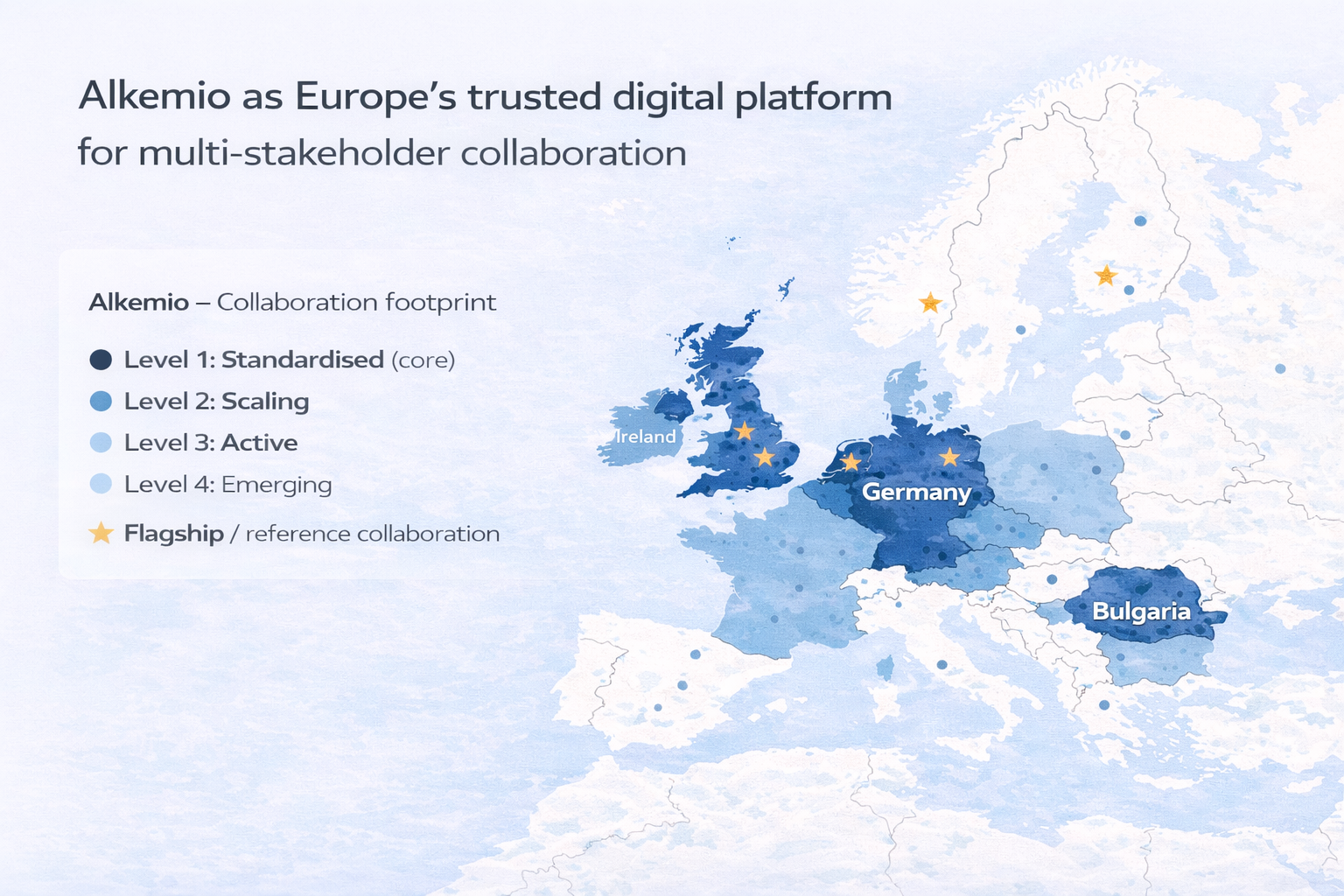
Alkemio has become Europe’s trusted digital platform for collaborations in the spaces between organizations.
Governments, organizations, universities and citizens seamlessly connect through Alkemio as an open digital environment to work together on complex challenges. Whenever a new public innovation project starts in the Netherlands, Germany or France, the question isn’t if Alkemio will be used, but how.
From climate adaptation to mobility, from housing to education, Alkemio is the default place to organize serious collaboration with stakeholders from multiple organizations around complex public challenges.
The Dutch public sector, the initial beachhead market, has now standardised on Alkemio collaboration involving stakeholders from multiple organizations and citizens. From there, adoption has spread across Europe: there are communities using the platform in Germany, France, the Nordics and beyond — and increasingly in other parts of the world. Multiple types of clients are used to interact with the platform, and the work to allow federation of Alkemio instances is starting.
Alkemio is now widely described as:
“The platform for collaboration in the spaces between organizations, because society’s challenges exceed any single organization. Built on openness and public values, so that the value of a digital platform is created and shared together, not captured by a few.”
Governance as a Third Way
Alkemio’s governance is an inspiring example of a third economic model: neither state-run nor shareholder-driven, but steward-owned, non-profit-led and commercially effective.
The Alkemio Foundation plays a central role: stimulating better multi-stakeholder collaboration (MSC), safeguarding the mission, and actively engaging decision-makers across Europe to explore this “third way”. Alkemio is not just using this model — it is demonstrating that you can build and scale digital infrastructure for the public good at market speed.
In doing so, Alkemio acts as an inspirator for governments, institutions and organizations looking for alternatives to purely commercial or purely public models.